Technology Transforms Health Sciences
For the last 40 years, Simpson has enjoyed the rare distinction of offering a human cadaver lab experience for upper-class students studying anatomy. That unique privilege has been pivotal in preparing students to compete for top graduate school placements enroute to rewarding careers in a wide variety of healthcare professions.
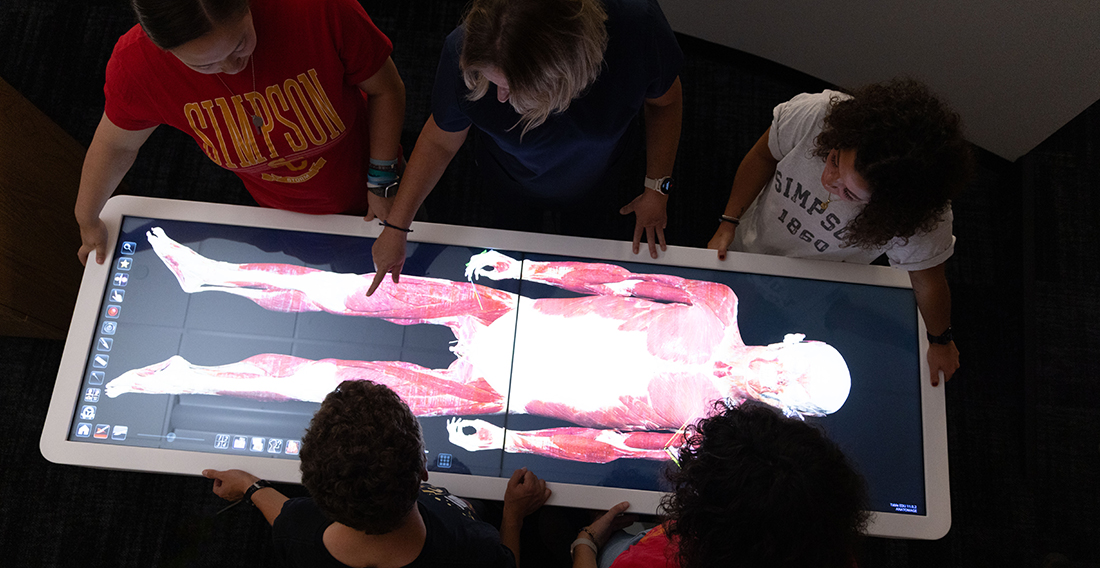
Now interactive technology has arrived that promises to take such learning to new heights. Thanks to a $135,000 grant from the Roy J. Carver Charitable Trust, Simpson has acquired an 84-inch, life-sized Anatomage virtual dissection table and 14 touchscreen tablets that will open exciting avenues in dynamically interactive learning.
The new technology will benefit more than 600 Simpson students across a variety of health-related programs, including biology, health and exercise science, neuroscience, psychology, forensic science and biochemistry. It will also serve students pursuing pre-professional tracks such as pre-medicine, pre-physical therapy and other allied health fields.
Learning Tool Like No Other
The Anatomage Table (AT) — a leading-edge platform for threedimensional, virtual dissection — will supplement Simpson’s current cadaver lab and 3D modeling tools. The AT greatly enhances anatomy study while making it possible to perform all kinds of intricate virtual dissections by providing a remarkably comprehensive and detailed view of the entire human body — including individual cells, nerve networks, muscle structures and organ systems.
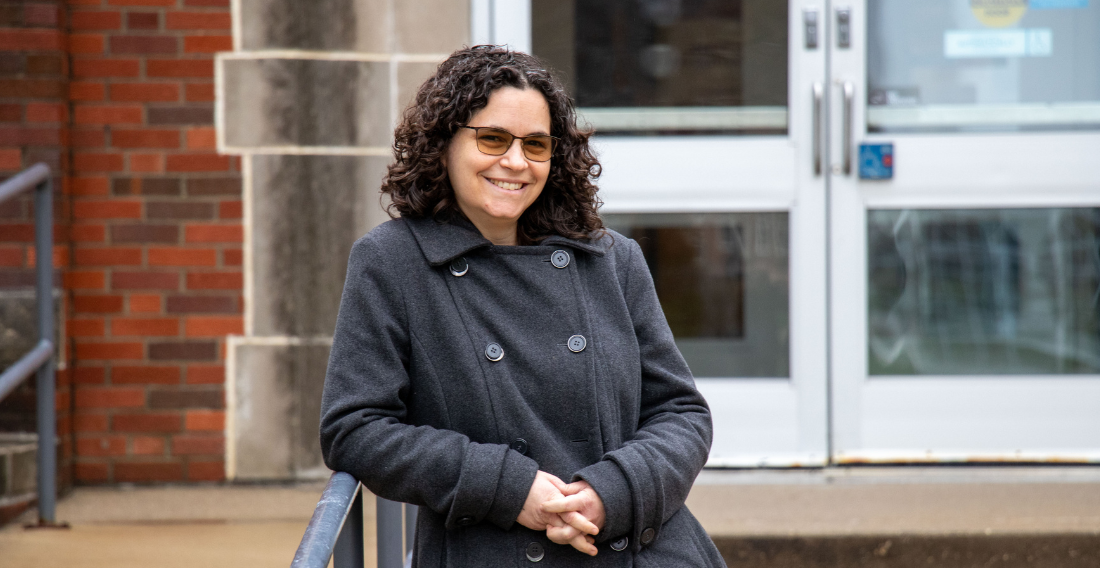
Dr. Lauren Points, assistant professor of biology, says the AT will provide an invaluable “pre-lab” dissection experience for students that better prepares them for what they will encounter in the physical cadaver lab.
“To this point, we’ve been using pre-lab videos to help students prepare,” said Points. “But it was difficult to get a camera in [the cadaver] to help students visualize what they’re supposed to be seeing. And that can be frustrating, because once you dissect something from a cadaver, it’s dissected — you can’t go back and do it again. The AT will make it much easier for students to know what they’re looking for ahead of time and perform more effective dissections.”
Biochemistry major Payton Seo ’26 agrees that the AT will help eliminate the confusion and guesswork that sometimes happens when you’re working in the anatomy lab.
“When you get to a ton of muscles, it’s hard to know if you’re right or wrong [about which muscles are which] if you don’t have somebody there with you,” said Seo. “The Anatomage Table has all the muscles labeled and you can tap them to see where they are so you can make sure you’re memorizing the correct things in the correct form.”
“I think [the AT] will be helpful not only for memorization, but also for learning movements and functions,” added Corteney Louis ’26. “Being able to visualize what those things look like on an actual cadaver before you make an incision in the lab will be really helpful.”
Virtual Versatility
Beyond its many obvious applications in human anatomy courses, the AT is designed to be leveraged for a multitude of purposes across disciplines.
“You can use it in physiology courses, for example, to see how ECG readings are affected during a heart attack,” said Dr. Faithe Keomanivong, assistant professor of biology. “You can also conduct different experiments in physics and chemistry. And in my comparative anatomy course, we’ll be able to use it to dissect different animals. It’s really going to help a wide variety of students.”
Students say they are especially excited to use the tablets, which replicate AT content to allow real-time engagement with labs and lectures. Most of all, the tablets’ portability will make collaborative work and solo study equally impactful and convenient.
“The tablets are going to be very helpful in both class and the lab — and just studying alone,” said Seo. “There’s only so many people you can fit around the AT or around a cadaver at one time. So, having 14 tablets to share in small groups or on your own will be very beneficial in getting the content repetition you need.”
Elevating Academic Performance
Points says multiple studies confirm that using the AT, tablets and physical cadaver lab in tandem plays a huge role in raising academic performance and helps significantly in preparing students for the rigors of graduate school.
“I’m going to have to do more cadaver labs in grad school,” said Savana Walls ’26. “It’s very important to me that going into that I know what I’m doing because I’ve had that experience here. I’ll just be much more comfortable.”
Article Information
Published
December 15, 2025
Author
Roger Degerman